
Kazakhstan Identifies 14 High-Risk Mountain Lakes Prone to Outbursts
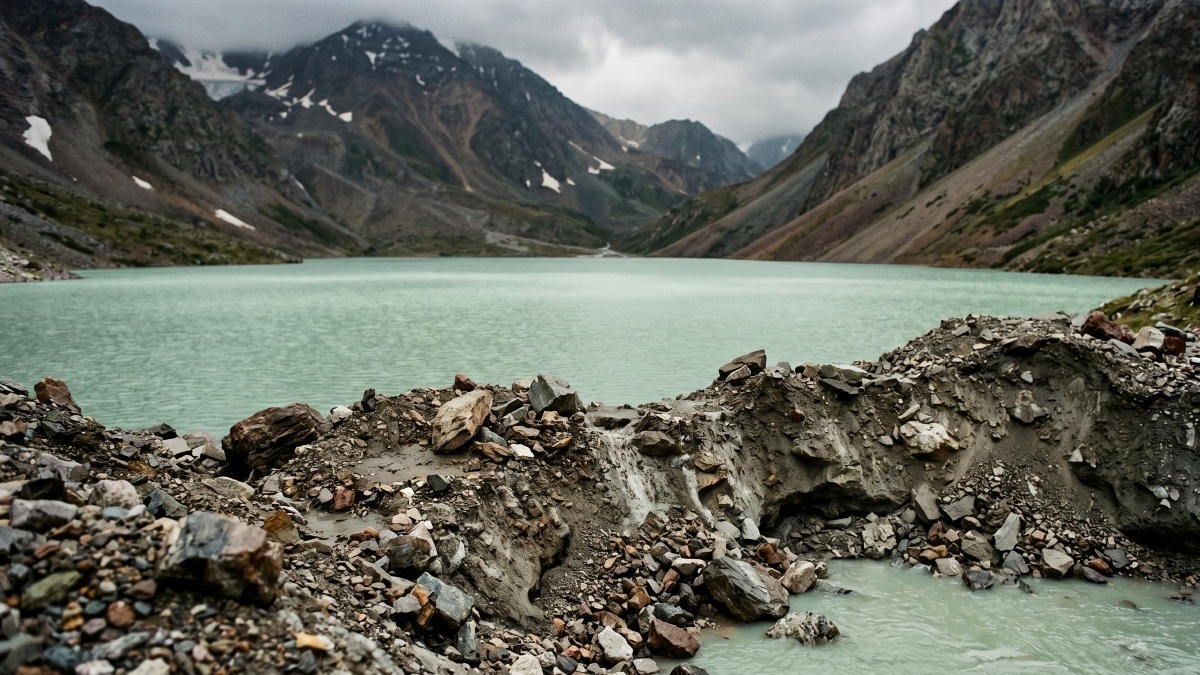
In 2026, specialists in Kazakhstan identified 14 mountain lakes at risk of sudden outburst floods that could trigger severe mudflows. Bauyrzhan Abishev, deputy head of the Kazselezashchita agency under the Ministry of Emergency Situations, detailed these findings at the Regional Environmental Summit in Astana.
Outburst-prone lakes form in high-altitude regions behind natural dams composed of rock debris, ice, or moraines. When these barriers fail, water surges downward, sweeping up mud, stones, and rock fragments. Three of the 14 identified lakes pose a direct threat to residential areas. Approximately 98 infrastructure facilities and 75,000 people are located within the potential impact zone.
The hazard is well documented in Kazakhstan, as the city of Almaty has experienced six destructive mudflows in its history. The city is situated at the foothills of the Trans-Ili Alatau mountain range, an area containing a significant concentration of these potentially dangerous water bodies.
Operations to lower water levels in these lakes are conducted under exceptionally severe conditions. The sites are located at elevations between 3,500 and 3,700 meters, with no access roads available for most locations. Upon completion of water drainage procedures, on-site observers remain to monitor the areas until the mudflow season concludes. Within the transboundary Khorgos River basin, nine out of 36 lakes are classified as prone to outbursts. Authorities have deployed 13 automated stations equipped with sensors for water level, temperature, precipitation, and seismic activity in that region.
The problem extends far beyond Kazakhstan. Kamal Kishore, the Special Representative of the UN Secretary-General for Disaster Risk Reduction, noted at the summit that only a marginal percentage of glacial lakes globally undergo systematic monitoring. A single outburst flood can destroy 250 megawatts of power generation infrastructure in under ten minutes – a scenario that has already been documented in previous incidents.
A primary structural challenge involves the limited scope of monitoring services, which typically cover only a fraction of known lakes. Outbursts frequently occur at unmonitored sites that remain off the radar. With certain lakes positioned above 4,500 meters above sea level, the installation and maintenance of monitoring equipment become highly complex technical challenges. “Every time we are caught off guard,” the UN representative stated.