
Tajikistan to Launch 500 MW of Solar Power to Address Winter Energy Deficit
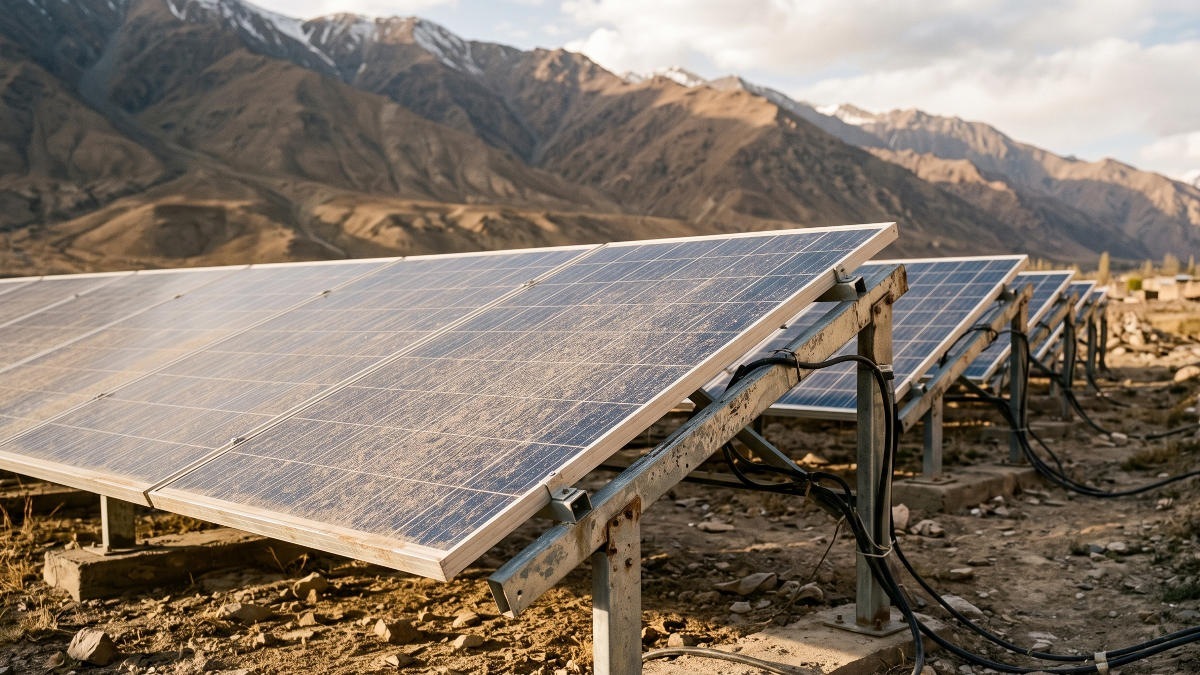
Tajikistan is set to commission two major solar power plants in the Asht district of the Sughd region and the Khatlon region by late 2026. These facilities will provide a combined capacity of 500 megawatts. Simultaneously, smaller–scale stations are under construction in the Gorno–Badakhshan Autonomous Region to supply remote and inaccessible settlements where extending traditional grid infrastructure is technically challenging and cost–prohibitive.
This decentralized approach is considered economically justified in regions where the costs of transmission lines, network losses, and ongoing maintenance outweigh the production cost of hydroelectric power. Local generation serves as a strategic alternative for remote areas, a logic Tajikistan is increasingly applying to its energy infrastructure projects. The integration of energy storage systems remains a critical factor for the success of these programs, as solar generation requires storage to ensure a stable supply.
These new stations are expected to reduce the burden on hydroelectric plants during winter months when river flow decreases and consumption peaks. For the broader energy system, the diversification of sources provides a buffer against the structural challenges of the winter season. Technological benchmarks for these high–altitude renewable energy projects include existing developments in China, which has extensive experience in high–elevation renewable infrastructure.
Winter energy shortages persist as a central problem for the Tajik power system. With approximately 98% of the country’s electricity generated by hydroelectric plants, the national energy balance remains highly dependent on river levels, annual precipitation, and glacier melt rates. Consequently, seasonal supply restrictions in remote districts have been a recurring necessity for many years, highlighting the risks of relying on a single power source.
Environmental organizations, including the international coalition Rivers without Boundaries, have advocated for energy diversification as a more sustainable path than the current plans for the Rogun Hydropower Plant on the Vakhsh River. Analysis of the project suggests that even completing the dam to its maximum height of 335 meters would fail to eliminate the winter energy deficit before 2036. This maximum dam scenario involves significant costs, including the forced resettlement of approximately 40,000 people and environmental risks to the Tigrovaya Balka Nature Reserve, a UNESCO World Heritage site.
The large–scale dam project also threatens the last populations of endangered shovel–nosed sturgeon in the Vakhsh River and risks altering downstream flow regimes. Such changes would impact irrigated agriculture supporting at least 7 million people across Tajikistan, Uzbekistan, Turkmenistan, and Afghanistan. As an alternative, a smaller–scale Rogun project—featuring a dam height reduction of approximately 70 meters—combined with the accelerated development of solar and wind generation has been proposed.
This hybrid configuration could potentially eliminate the winter energy deficit as early as 2030–2031. Funds saved from the reduced dam construction could be redirected toward solar power infrastructure, which is less vulnerable to hydrological risks. Existing hydroelectric plants would complement solar power by managing night–time and peak loads. A smaller reservoir would result in less disruption to river flow and reduce resettlement requirements by roughly two–thirds.
The cost of solar generation is currently lower than that of large–scale hydroelectric projects, and its carbon footprint is significantly smaller than high–capacity reservoir scenarios. Diversification into renewable sources is intended to supplement rather than replace hydropower, transitioning toward a more resilient energy configuration less susceptible to climate fluctuations. While the current 500–megawatt solar projects are modest compared to the planned capacity of the Rogun plant, their impact on the winter energy balance will depend on implementation timelines, storage capacity, and the condition of distribution networks.