
Water shock: Kazakhstan has halved the limit on the Syr Darya for 2026
The republics of Central Asia have distributed among themselves their main and common strategic resource, which is more expensive than any gold – water. While the world is watching oil, survival maps for the next year are being drawn here. Two great arteries, the Amu Darya and the Syr Darya, continue to bring life to the arid steppes. inbusiness.kz .
Prior to that, Kazakhstan, Uzbekistan and Tajikistan agreed on the joint operation of the Bahri Tojik reservoir, which means “Tajik Sea” in translation. This event took place in Dushanbe on May 30, 2025 on the sidelines of the high-level international Conference on glacier conservation.
At the same time, the three republics agreed on a joint operation regime of the Bahri Tojik reservoir for the summer of 2025, having formalized the agreements in the trilateral protocol. The reservoir was formed in 1950 by a dam and a hydroelectric power station erected to regulate the flow of the Syrdarya River.
Now, following the results of the 91st meeting of the Interstate Coordination Water Management Commission of Central Asia (ICWC), 5 countries of the region have already divided water for 2026. The meeting approved the limit of water intake from Amu Darya and Syr Darya for 2026. The mode of operation of the Tajik Sea for the summer period has also been agreed.
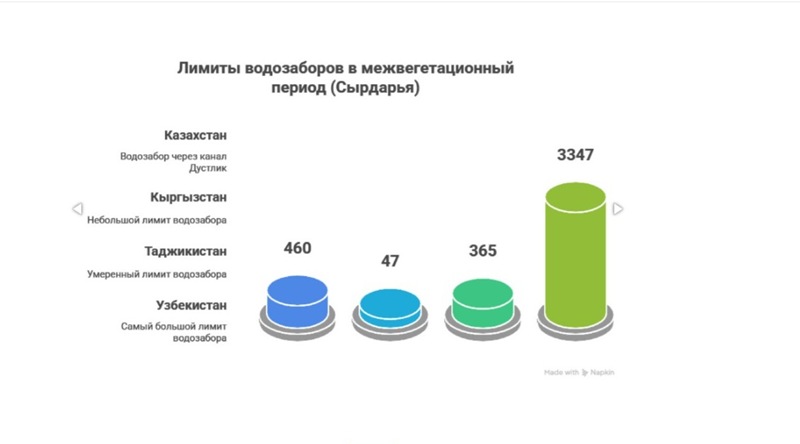
Unfortunately, Kazakhstan will get almost two times less water next year. In the Syr Darya for 2026, the total limit of water intakes for the intervegetation period will be 4.2 billion cubic meters.
The Syr Darya is highlighted:
- Kazakhstan (through the channel “Dustlik-Dostyk”) – only 460 million cubic meters;
- Kyrgyzstan – 47 million m3;
- Tajikistan – 365 million m3;
- Uzbekistan will receive the main share, or 79.3% of the total volume, and its share will be 3.347 billion cubic meters.
According to the ICWC, these figures are calculated taking into account the expected inflow, reserves in reservoirs and the need to preserve ecological runoff in the riverbed.
For comparison, based on the protocol of the 89th meeting of the ICWC, in 2025 the limit of water intake for Kazakhstan (via the Dustlik channel) It amounted to 909 million, for Kyrgyzstan – 270 million, for Tajikistan – 1 billion 905 million, and for Uzbekistan – 8 billion 800 million cubic meters.
Why was the limit halved?
In the Syr Darya, the picture came out more complicated than in the Amu Darya. It was a paradox: the inflow to the upper reaches was off the scale (119%), but by the end of the season the reservoir bowls turned out to be half empty. Toktogul “did not collect” half a billion cubic meters, and Shardara gaped at all with a deficit of 576 million cubic meters.
Why not? The paradox is explained simply: in order to save the ecosystems of the lower reaches and prevent the river from turning into a salt marsh, the services of Kazakhstan, Kyrgyzstan, Tajikistan and Uzbekistan agreed on increased discharges. Only the old stocks and the fraternal consent of the neighbors helped to avoid the great land.
According to the Asia-Plus portal, forecasts of the Hydrometeorological Center of Uzbekistan showed that in different parts of the basin the water will be from 70% to 105% of the norm. In fact, the total inflow to the upper reservoirs turned out to be even higher than expected – 6 billion 119 million cubic meters, or a record 119% of the norm.
It would seem that this is good news, but by the end of the season it turned out that there is less water in the reservoirs themselves than planned. As it was said, the Toktogul reservoir did not collect more than half a billion cubic meters, the Andijan reservoir – about 320 million, the Charvak reservoir – 428 million. In the Bahri Tojik and Shardara channel reservoirs, the deficit amounted to 217 million and 576 million cubic meters, respectively.
In general, the cascade was missing about 2.1 billion cubic meters compared to the forecast. Despite this, during the intervegetation period of 2024-2025, more water was discharged from the cascade than planned, by almost 1.8 billion cubic meters. Increased releases were needed to maintain sanitary runoff in the riverbed and provide water to the country downstream.
However, even with a shortage in some reservoirs, the irrigation season of 2025 in the Syr Darya passed without critical problems. The reserves of previous years, additional inflow and coordinated work of the services of Kazakhstan, Kyrgyzstan, Tajikistan and Uzbekistan helped, the ICWC reports.
How will the Amu Darya water be divided?
In the Amu Darya, the commission was most interested in two things: whether the countries had enough water in the outgoing year and whether they managed to keep the flow level in the lower reaches, where there are many fields and millions of people live.
The 2025 season was like a roller coaster. In spring, the river was “capricious”: the whole season the inflow of water fluctuated greatly. At the “Kerka Alignment” (a control point on the Amu Darya River, which is used for monitoring and managing water resources in the Amu Darya basin), the water content was about 93% of the norm, slightly lower than a year earlier.
But in August and September, the mountains “burst into tears” – under the scorching sun of abnormally hot August, the melting of glaciers intensified, the water became more than usual – up to 115% of the norm. This saved the lower current, allowing the Nurek and Tuyamuyun reservoirs to accumulate the necessary reserves by the end of the season to quench the thirst of the fields. Their reservoirs worked as perfect dampers, preventing a collapse in the lower reaches.
The countries drew from this cup as carefully as possible: during the growing season, the countries used approximately 86% of the approved quotas for the Amu Darya. Turkmenistan, where water-saving technologies are used at a minimum level, drank almost to the bottom of its limit (92%). The other two republics left a good part of the water in the riverbed: Tajikistan chose about 83% of its volume, Uzbekistan – about 82%. Below the target of the Kerk, the actual use was 87.4% of the total limit.
The Nurek and Tuyamuyun reservoirs operated in the mode of regulated releases: the first smoothed out flow fluctuations, the second promptly supplied water to the downstream. Due to this, there were no serious failures in the water supply of fields and settlements of these three republics.
At the last meeting of the ICWC, Dushanbe, Ashgabat and Tashkent agreed on how to use water in the upcoming inter-migration period of 2025-2026. In the Amu Darya, the total water intake limit for the water management year from October 2025 to October 2026 is set at about 55.4 billion cubic meters. Of these, 15.9 billion cubic meters fall during the cold period – from October to April.
The Amu Darya is highlighted:
- Tajikistan – 9.8 billion;
- Turkmenistan – 22 billion;
- Uzbekistan – 22 billion cubic meters per year.
Separately, the volume of water for the Aral Sea and the Amu Darya Delta is 4.2 billion cubic meters, half of which is supplied in winter and early spring. Sanitary and ecological releases to the irrigation systems of Dashoguz Velayat, Khorezm region and Karakalpakstan will amount to another 800 million cubic meters. This is important for the conservation of floodplain ecosystems and for the population of the Aral Sea region, which already lives in conditions of water scarcity.
What will happen to the reservoirs in the new year?
The Commission also approved the operating modes of the largest reservoirs. In the Syr Darya, the total water reserves in the Toktogul, Andijan and Charvak reservoirs at the beginning of the intervegetation period are estimated at about 10.6 billion cubic meters, which is slightly below the norm.
About 2.6 billion and 1.65 billion cubic meters are expected in Bahri Tojik and Shardara, respectively.
In total, by the beginning of winter there will be about 14.9 billion cubic meters of water in the reservoirs of the Syr Darya basin – about 90% of the average annual level. This leaves less safety margin, so the cascade operation mode will be more careful.
The main question still remains unanswered: is it enough to water people, livestock and land? Will the Central Asian republics be able to pass the new year, 2026, without “wars” over water?
The media write that Kazakhstan, which is located in the lower reaches, may suffer the most. According to CACF experts, in Kazakhstan, despite the presence of more than 85 thousand rivers and over 48.2 thousand lakes, the issue of shortage of quality water is acute.
Earlier, the publication noted that the Government of the Republic of Kazakhstan warned about the risks of the low-water season. The republic is forced to revise the structure of crops for 2026. It is recommended that Kazakhstani farmers adapt their crops in advance to the expected limitation of water resources.
“The inflow of water to the Naryn-Syrdarya cascade has significantly decreased, which creates a risk of water scarcity during the growing season next year. The Ministry of Water Resources has developed several forecast modes of operation of reservoirs and scenarios for the redistribution of resources with minimal inflow. This will allow to adjust the limits of water use and reduce the risks of shortage,” the press service of the Cabinet of Ministers of Kazakhstan explained.
It seems that 2026 will be a time of strict hydrological diet. The water “pie” has already been divided: but behind this division lies the dramatic struggle of the region with the climate. A year can turn into a test of strength for friendship, brotherhood and good neighborliness.
What’s next? We are expecting spring data on melting – they will show whether these limits will remain on paper or turn into a real stream of life.
Zhanat Ardak (inbusiness.kz )
Original (in Russian): Водный шок: Казахстану вдвое урезали лимит по Сырдарье на 2026 год