
The Taliban is digging a massive canal and rebuilding a giant tunnel in Afghanistan
Although the Taliban has consolidated control in the country since 2021, the Taliban regime is now accelerating the construction of a giant artificial canal, reopening a strategic tunnel and signing memoranda with China to monetize trillion-dollar mineral reserves, promising jobs, energy and irrigation in Afghanistan, which is still marked by poverty, sanctions and constant diplomatic isolation in the eyes of the rest the world.
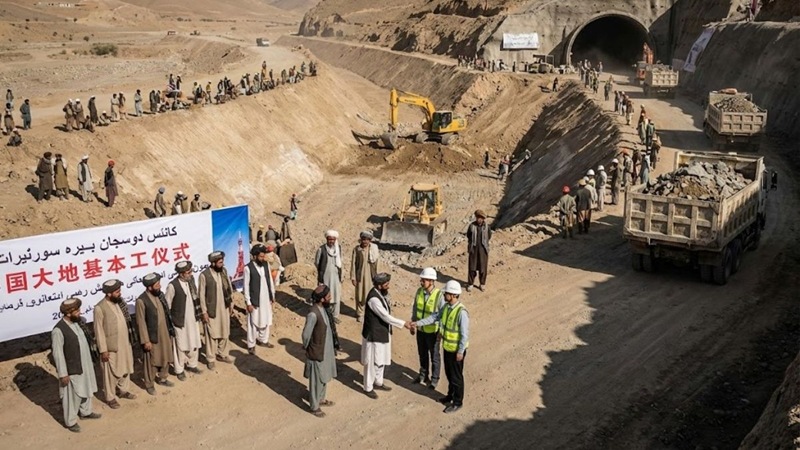
Since August 2021, when the Taliban regained power in Kabul, the country has entered a new phase of projects presented as “historic.” In the period from 2023 to 2025, the regime has placed at the center of its domestic agenda a giant artificial canal in the north, the reconstruction of a mountain tunnel with a tragic history and a series of preliminary agreements with Asian partners.
In 2025, this strategy has acquired clearer outlines: the Taliban is trying to sell the world the image of Afghanistan, capable of freeing itself from dependence on international aid, using trillions of dollars worth of undiscovered minerals. The combination of megaprojects, promises of irrigation, energy and heavy mining is presented as a way to turn a poor country into a platform for money and regional power.
An artificial canal in the north is becoming a showcase of the Taliban’s hydrotechnical ambitions
At the center of this plan is a giant artificial canal in northern Afghanistan, promoted by the Taliban as the largest project of its kind in Asia.
The route passes through traditionally arid regions and is aimed at diverting water from a large river to supply agricultural areas and, theoretically, in order to make productive areas that currently depend on irregular rainfall.
For the Taliban, this project proves that the regime can create heavy infrastructure without relying on Western organizations.
Government officials have repeatedly stated that the canal can irrigate hundreds of thousands of hectares and reduce food insecurity, although they do not present with the same transparency complete studies of the impact on water runoff in neighboring downstream countries.
Independent experts, both inside and outside the country, warn that a canal of this size, run by an isolated government with few oversight mechanisms, could lead to water disputes with neighbors, environmental imbalances and the concentration of benefits from groups associated with the Taliban itself.
The lack of reliable public data on the volume of diverted water, the actual timing and total cost increases doubts around the project.
The Kush Tepa Canal, the Taliban’s ambition and its cascading effect on the region’s water supply
The channel, which the Taliban turned into a showcase of infrastructure, has a specific name and scale: Kush Tepa.
Planned to stretch approximately 285 kilometers in northern Afghanistan, it began to be excavated shortly after the Taliban returned to power in 2021, and about half of the canal’s route has already been completed, with the goal of full commissioning by 2028.
The official promise is that the Kush-Tepa canal will divert up to 10 cubic kilometers of water per year from the Amu Darya River – about a third of its total flow – to irrigate now dry agricultural land and reduce dependence on imports of wheat, vegetables, fruits and other basic foodstuffs.
The Taliban is selling the canal as a solution for a country where agriculture provides employment for most of the population, but where there is not enough water even for domestic consumption in several areas.
The regime also links Kush-Tepa with a long-term strategy to reduce the economy’s dependence on opium.
Before the Taliban returned to power, drug trafficking was estimated to account for a significant portion of GDP, in part because poppy requires much less water than food crops.
The official rhetoric now is that by guaranteeing irrigation, the canal will convince farmers to abandon poppy cultivation in favor of legal crops with state support.
The water crisis in Central Asia and the tensions fueled by the Taliban Channel
The problem is that Kush-Tepa does not exist in a vacuum.
The Amu Darya already supplies Uzbekistan, Turkmenistan and Tajikistan, countries facing growing water shortages for both irrigation and human consumption.
By sharply involving Afghanistan in a dispute over the same river, the Taliban project threatens to destabilize the already fragile water balance.
Across Central Asia, a combination of population growth, urbanization, industry, and intensive cotton irrigation is putting pressure on rivers and aquifers.
One kilogram of cotton fiber can require tens of thousands of liters of water, and this model has become one of the causes of the death of the Aral Sea.
The region has already seen street protests due to water shortages, “water wars” on the borders and even armed clashes between Tajikistan and Kyrgyzstan in 2021 – all these are symptoms of a water system operating at the limit of its capabilities.
In this context, the Taliban Canal adds a new significant consumer to the river, which many already consider to be overloaded.
Countries such as Uzbekistan and Turkmenistan, the main irrigators of cotton, fear losing some of the water that feeds their agricultural systems, while Tajikistan, Kyrgyzstan and Kazakhstan also deal with episodes of scarcity that force residents to buy water in cans or rely on water carriers during periods of severe drought.
At the same time, Afghanistan claims that it has the right to use the Amu Darya: about 30% of the runoff originates on its territory, and historically the country has used a minimum share of water compared to its neighbors.
For the Taliban, Kush Tepa is a correction of “historical injustice”; for downstream countries, it is a potential trigger for political, economic and environmental conflict.
The right to water, coordination failures and risks of structural accidents
From a legal point of view, no country in the region denies that Afghanistan, currently controlled by the Taliban, has the right to use part of the waters of the Amu Darya.
The main concerns revolve around the lack of a modern sharing agreement, a lack of regional coordination and the technical quality of the work.
The canal does not have proper lining for most of its length, which increases water loss due to seepage into sandy soil and creates a risk of breakouts.
Shortly after the opening of the first section in 2023, a segment of the coastline collapsed, flooding the surrounding area and forming an artificial lake with an area of more than 30 square kilometers.
The Taliban-linked authorities have not publicly acknowledged the accident, raising concerns about transparency, monitoring and the ability to respond in case of future failures, especially in a structure designed to divert huge volumes of water.
Although the neighbors do not officially recognize the Taliban government, they are trying to maintain informal channels of communication with Kabul.
Taliban representatives are received as guests at regional conferences in the hope of involving them in joint solutions on water, energy and infrastructure, while Uzbekistan, Turkmenistan and Tajikistan invest in electricity and gas pipeline projects on Afghan territory.
However, so far this has not changed the regime’s position regarding the channel, which is considered as a strictly internal matter.
The combination of a water project of this scale, the lack of a sharing agreement, the climate crisis and the aging infrastructure in Central Asia pushes the situation by inertia to a kind of shock.
The central question is whether the Taliban and its neighbors will be able to turn the Kush Tepe Canal into a point of cooperation and modernization, or whether the canal will be remembered as a trigger for a regional crisis of water, security and political legitimacy.
Reconstruction of a deadly tunnel in a strategic mountain corridor
Another pillar of the Taliban’s infrastructural rhetoric is the reconstruction of a mountain tunnel vital to connecting the north and south of the country, often described as “gigantic” and having a history of fatal accidents over decades of use.
This corridor is necessary for the transportation of goods, fuel and food during the harsh winter months.
The version presented by the regime states that the new structure will be safer, better ventilated and controlled, correcting the accumulated technical shortcomings and reducing the risk of fires, congestion and mass deaths of people already recorded there in the past.
By posting photos of construction works, structural fortifications and equipment, the Taliban is trying to demonstrate its ability to manage a high-risk facility.
Critics point out that without clear international safety protocols, independent technical audits and transparency regarding emergency materials and systems, the reconstructed tunnel may still remain a vulnerable place, especially in a country with a history of irregular maintenance and difficulties in responding quickly to disasters in remote areas.
The Taliban, China and the geopolitical use of infrastructure
In parallel with internal work, the Taliban is seeking closer ties with China in an attempt to break through diplomatic isolation.
The strategy includes memoranda of understanding on infrastructure, mining and the potential inclusion of sections of Afghan territory in logistics corridors related to Chinese regional projects.
The rhetoric emphasizes that Afghanistan can become a link between Central Asia, South Asia and the rest of the continent.
On the Chinese side, the stated interest lies in access to shorter routes and strategic mineral reserves, while assessing the risks of instability and the lack of official international recognition of the Taliban government.
None of the parties discloses all the details of the signed agreements, fueling speculation about future mining concessions, road tolls and profit sharing in the energy and logistics sectors.
For the Taliban, any rapprochement with a world power serves as an internal argument of legitimacy.
The regime seeks to demonstrate that even under sanctions and without official recognition from a number of countries, it is able to attract foreign capital and technology, especially in exchange for privileged access to Afghanistan’s natural resources.
Trillions in Minerals: Between Promise and Economic Reality
The Taliban uses artificial waterways, mining and agreements with China in an attempt to turn impoverished Afghanistan into a platform for regional power and wealth.
Long before the Taliban returned to power, international studies estimated that Afghanistan’s subsoil could contain strategic minerals worth trillions of dollars, including copper, iron, lithium and rare earths.
Since 2021, the regime has referred to these estimates as the basis of a narrative about a “rich future” financed by the mining industry.
In practice, the conversion of this promise into income depends on factors beyond the physical possession of the ore.
Large-scale mining requires a stable energy supply, roads, railways, transmission lines, security for technicians and investors, as well as minimum rules for contracts and arbitration.
In the face of sanctions, banking restrictions and doubts about the fulfillment of obligations, many potential partners remain cautious.
There is also a risk that mining will concentrate revenues in circles close to the Taliban leadership, repeating corruption schemes already observed in other resource-rich countries, leaving local communities with only environmental degradation and forced relocation.
Without mechanisms of transparency and income distribution, the “wealth of the subsoil” may never be transformed into a broad improvement in social indicators.
Infrastructure, internal control and human cost
Projects such as an artificial canal and a reconstructed tunnel also serve as instruments of political control for the Taliban.
By deciding where the water will go, which regions will be connected by roads, and who will get construction jobs and contracts, the regime strengthens ties with allies and marginalizes areas considered hostile.
Human rights organizations point out that investments in concrete and steel go hand in hand with restrictions on civil liberties, the closure of spaces for women and girls in education, and severe restrictions on the press and civil society.
Creating an image of “Afghanistan under construction” coexists with accusations of systematic violations, which makes it difficult for democratic governments to justify any direct economic rapprochement.
In the long run, the central question is whether the Taliban’s bets on megaprojects, mining and selective agreements will be enough to reduce poverty and external dependence, or whether this will only create a new layer of elites associated with the regime, keeping the majority of the population in a vulnerable position.
Given this scenario of giant canals, reconstructed tunnels and a race for minerals, in your opinion, is the Taliban really paving the economic future for Afghanistan, or are they just using large-scale projects as a showcase, while the population remains trapped in poverty and disenfranchisement?
Bruno Teles (Click Oil and Gas)
Original (in Russian): Талибан роет массивный канал и восстанавливает гигантский туннель в Афганистане